
Full course description
The Behavioral Health Responder (BHR) Certification prepares professionals across sectors to effectively respond when individuals experience behavioral health challenges or crises. Designed for professionals whose primary role may not be behavioral health but who are often called upon to support people in distress.
The program is designed for working professionals and balances rigor with flexibility.
Format: 8-week structured hybrid training program
Total Time Commitment: 105 hours (combination of asynchronous and in-person learning)
- Fridays: 5:00–9:00 p.m.
- Saturdays: 8:00 a.m.–4:30 p.m.
Participants complete online learning prior to each in-person session and then apply their learning through engaging facilitated discussion, case application, and structured skills practice.
Next Program Dates (Spring 2026 Cohort)
| Date | Module(s) | Time |
|---|---|---|
| Fri, March 13, 2026 | Module 1 | 5:00–9:00 p.m. |
| Sat, March 14, 2026 | Module 2 | 8:00 a.m.–4:30 p.m. |
| Fri, March 27, 2026 | Module 3 | 5:00–9:00 p.m. |
| Sat, March 28, 2026 | Modules 4–5 | 8:00 a.m.–4:30 p.m. |
| Fri, April 3, 2026 | Module 6 | 5:00–9:00 p.m. |
| Sat, April 4, 2026 | Modules 7–8 | 8:00 a.m.–4:30 p.m. |
| Sat, April 25, 2026 | Module 9 and Program Closing | 8:00 a.m.–2:00 p.m. |

Through a structured, nine-module sequence that blends online learning with in-person skill-building, participants develop practical competencies in:
- Understanding behavioral health across the lifespan and in context
- Recognizing common mental health concerns and patterns of substance use that may increase risk or impair functioning
- Assessing suicide risk and situational safety, and supporting stabilization during moments of crisis
- De-escalating highly charged situations and supporting emotional regulation
- Responding in trauma-informed ways that promote safety and reduce escalation
- Creating short-term support plans and connecting individuals to appropriate resources
- Maintaining personal and physical safety, boundaries, and sustainability in helping roles
These skills build progressively from foundational role clarity and communication to crisis stabilization, safety, and follow-through. The training emphasizes continual practice, case application, and facilitated skill development. Engaging, rather than overwhelming, this hands-on training is designed for participants from a variety of backgrounds and experiences.
Each module, after the introduction, focuses on a defined set of applied skills. These modules are paired with a digital badge issued through Carroll University via Credly.
- Introduction Module 1: The Role of the Behavioral Health Responder
- Module 2: Foundations of Effective Communication
- Module 3: Understanding Behavior Across the Lifespan
- Module 4: Trauma-Informed Responding
- Module 5: Mental Health and Substance-Related Concerns
- Module 6: Suicide Risk Awareness and Response
- Module 7: Assessing and Stabilizing in Moments of Crisis
- Module 8: Creating Support Plans and Resource Connections
- Module 9: Personal and Physical Safety
A brief description of each module, along with the key skills learned and resulting digital badge in Modules 2-9 can be found here.
 Frequently Asked Questions
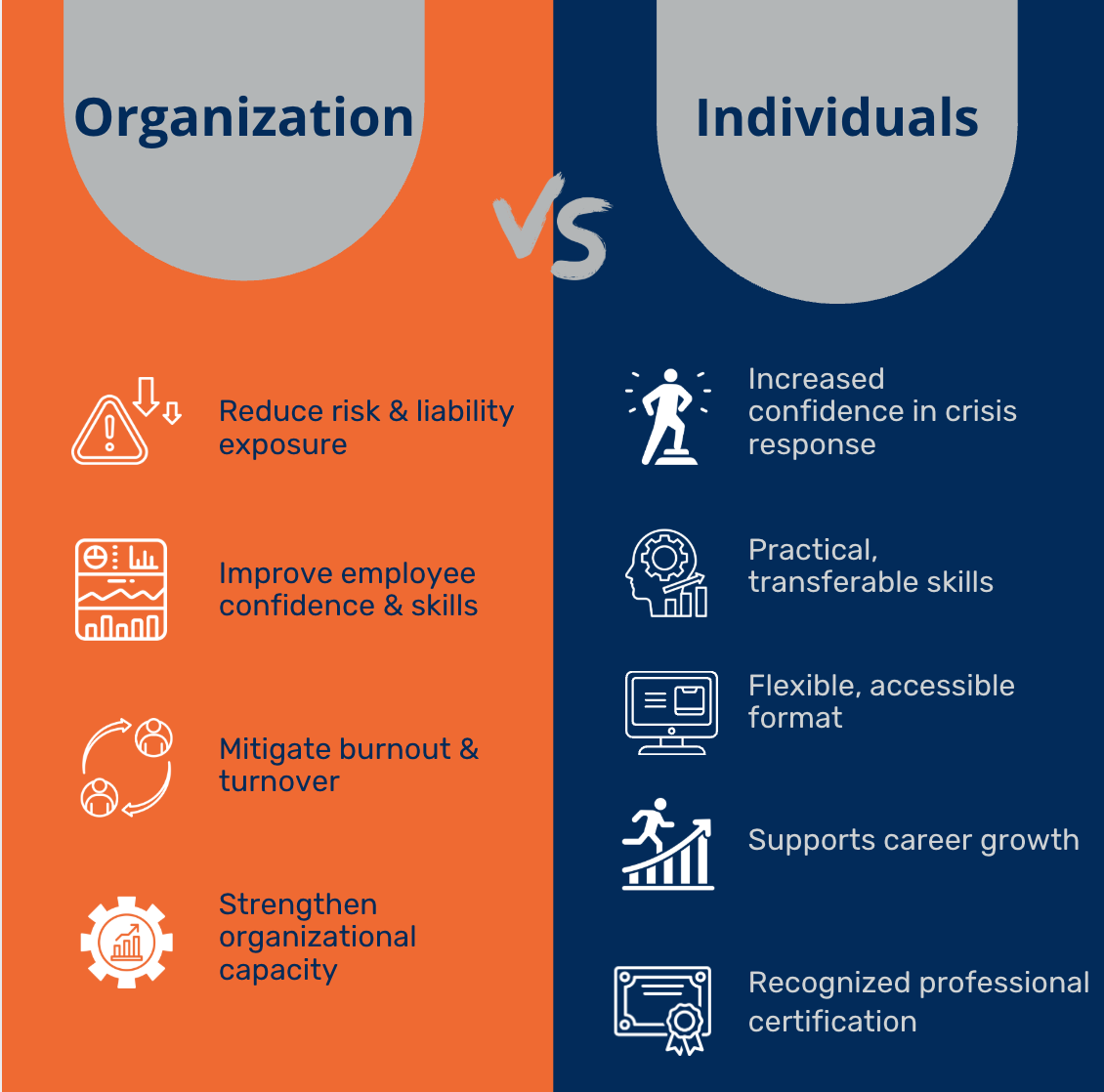
What's the return on investment of the BHR certification?
Is the Behavioral Health Responder Certification a clinical or licensure-based program?
No. The Behavioral Health Responder (BHR) Certification is a non-clinical training program. It does not prepare participants to diagnose, treat, or provide psychotherapy. Instead, the program focuses on recognizing distress, supporting stabilization and de-escalation, and connecting individuals to appropriate resources.
Do I need prior behavioral health training to participate?
No. No prior behavioral health training is required. The BHR program is designed for professionals across sectors whose primary role is not behavioral health but who may encounter individuals experiencing distress as part of their work.
How is the program delivered?
The BHR program is delivered over 8 weeks using a hybrid format that combines asynchronous online learning with in-person skill development sessions. Participants complete online learning in advance of each in-person session, then apply their learning through facilitated discussion, case-based application, and structured skills practice.
When do the in-person sessions take place?
In-person sessions occur approximately every two weeks and are held on:
-
- Fridays from 5:00 – 9:00 p.m.
- Saturdays from 8:00 a.m. – 4:30 p.m.
This schedule is designed to support working professionals while allowing sufficient time for in-depth learning and practice.
How many total hours does the program require?
The BHR Certification includes a total of 105 hours of learning, combining asynchronous coursework and in-person training.
What is the cost of the certification?
The cost of the Behavioral Health Responder Certification is $2,500 per participant.
Group and organizational discounts are available.
Is this program appropriate for teams or organizations?
Yes. The BHR Certification is well-suited for organizations seeking to strengthen their capacity to respond effectively to behavioral health needs across roles and settings. By training team members, organizations create resource multipliers by expanding internal knowledge, confidence, and response capability far beyond a single role or department. Group enrollment options are available.
While the BHR certification follows a consistent hybrid model, the scheduling, cadence, and on-site logistics of the in-person sessions can be tailored to align with an organization’s size, workforce structure, and operational needs without altering the core curriculum or learning objectives.